



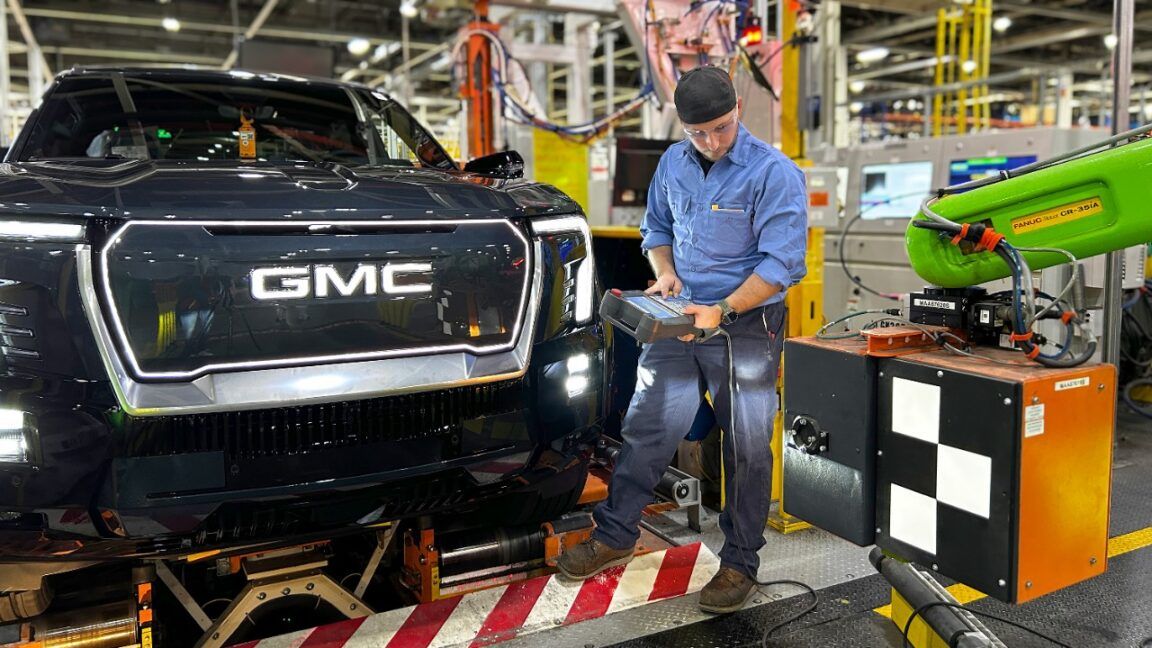
GM bets on robots while workers await return
General Motors is transforming its main electric vehicle factory in Detroit into a futuristic setting with the installation of dozens of robotic arms. This happens while 1,300 workers are still unemployed following layoffs that were supposed to be temporary. The arrival of the robots, manufactured by the Japanese company FANUC, has reignited the discussion about the impact of automation on the workforce, especially among members of the United Auto Workers (UAW) union.
FANUC's robots were designed to assist in assembling vehicle components, but the UAW is not pleased at all. James Cotton, president of UAW Local 22, expressed his outrage, stating that GM could have recalled some of the laid-off workers instead of investing in 50 robots. The situation is tense, as more than 1,000 union members remain on "indefinite layoff" since March.
The core issue is the balance between technology and human employment. Andrew Bergman, a union organizer and former GM employee, criticizes prioritizing profit over workers. He believes technology could make work safer and reduce working hours without pay loss, but in the hands of "bosses and billionaires," it serves to increase profits and cut jobs.
Automation: a global trend
The use of robots on assembly lines is not exclusive to GM. Other automakers like Stellantis and Ford are also adopting automation in their US operations. Hyundai, for example, plans to introduce Atlas humanoid robots, from Boston Dynamics, at its electric vehicle factory in Georgia by 2028. Meanwhile, in China, automation is already at an advanced stage. Companies like Xiaomi use hundreds of robots to produce electric vehicles and smartphones in highly automated factories.
However, complete automation is not without risk. Fully automated factories can face new challenges and vulnerabilities. Humans are still more effective at quickly identifying problems on the production line that could escalate in a fully automated system. Additionally, cybersecurity becomes an even greater concern in facilities dominated by robots and artificial intelligence.
Challenges and dilemmas of automation
Apesar dos desafios, muitas empresas estão apostando que a redução de custos trabalhistas e o aumento da capacidade de produção compensam os riscos. Em 2024, a China instalou 295.000 robôs industriais, enquanto os EUA instalaram 34.200. O plano quinquenal da China coloca a inteligência artificial e a robótica no centro de sua estratégia econômica até 2030, o que pode dar aos fabricantes chineses uma vantagem competitiva significativa à medida que a adoção global de veículos elétricos cresce.
GM, like other American automakers, faces a dilemma. While automation promises efficiency, union pressure and social issues cannot be ignored. The question that remains is: how to balance technological innovation with job preservation? This is a discussion that is far from resolved, but needs to be addressed urgently.
Comments (0)
Comments are moderated and if they violate our Terms and Conditions of use, the comment will be deleted. Persistence in violation will result in a ban of your account.